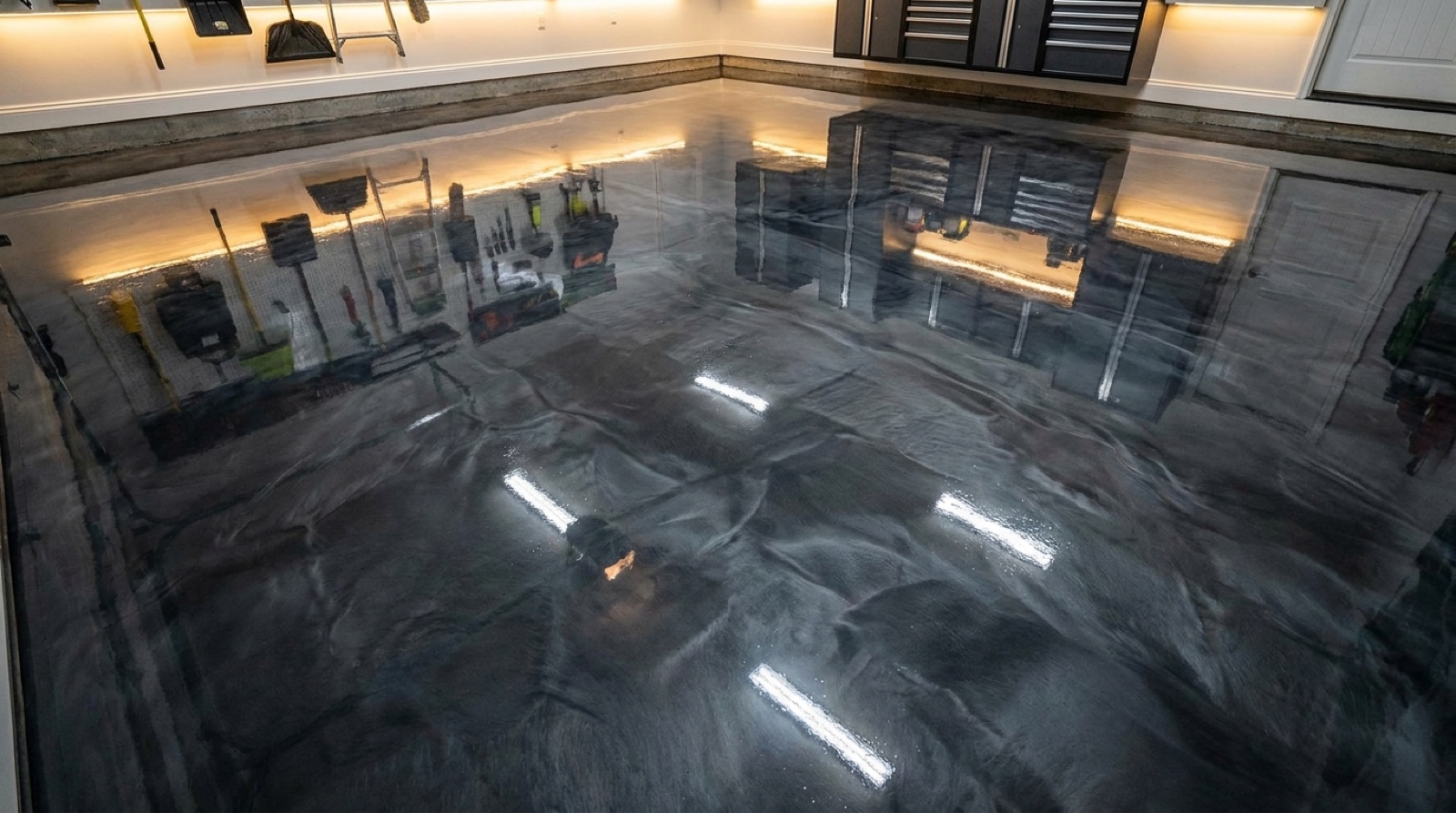
A professionally installed epoxy floor in a residential garage lasts 15 to 20 years. Commercial and industrial floors often run just as long, sometimes longer, when the coating is matched to the traffic it carries.
Those numbers assume the concrete was prepared correctly and the right product was used. A rushed one-day kit from a big box store rarely makes it past three years.
Lifespan by Setting
The environment matters more than the brand of resin. A floor that never sees a car will outlast one that gets daily hot tire contact and road salt every winter.
Here is what to expect across common Rochester settings.
| Setting | Typical Lifespan | Main Stress |
|---|---|---|
| Residential garage | 15 to 20 years | Hot tires, salt, dropped tools |
| Basement or interior | 20+ years | Light foot traffic, humidity |
| Commercial showroom | 15 to 20 years | Foot traffic, rolling loads |
| Warehouse or industrial | 10 to 20 years | Forklifts, impact, chemicals |
| Outdoor patio or driveway | 7 to 12 years | UV, freeze-thaw, moisture |
Outdoor numbers sit lower for a reason. Standard epoxy is not built for direct sun or the freeze-thaw cycles we get across Monroe County.
For exterior concrete, a UV-stable topcoat does the heavy lifting. Our polyaspartic floor coating holds color and gloss outdoors far better than epoxy alone.
What Shortens Epoxy Lifespan
Most failures trace back to a handful of causes. Almost all of them are avoidable.
Poor surface preparation
This is the number one reason coatings peel. If the concrete is not mechanically ground or shot blasted, the epoxy has nothing to grip.
Acid etching alone is not enough for a floor that needs to last two decades. Diamond grinding opens the pores so the resin bonds into the slab.
Moisture in the slab
Rochester basements and older garages often carry vapor pressure from below. When moisture pushes up through untreated concrete, it lifts the coating.
A moisture test before installation catches this. If needed, a vapor barrier primer goes down first.
The wrong product for the job
Thin water-based epoxy fails fast under vehicle traffic. A garage needs a high-solids build, ideally finished with a wear layer.
Our garage floor epoxy systems use a full-thickness base and a protective topcoat rather than a single thin pass.
UV exposure
Sunlight yellows and chalks standard epoxy over time. That is fine in a closed garage but a problem for a patio or outdoor surface.
How the Product Choice Affects Longevity
Not every floor should be pure epoxy. The finish you choose sets the ceiling on how long it lasts.
| System | Best For | Longevity Note |
|---|---|---|
| High-solids epoxy | Garages, basements | Strong base, needs a topcoat outdoors |
| Polyaspartic | Fast cure, UV areas | Resists yellowing and abrasion |
| Flake or chip | Homes, showrooms | Hides wear, adds slip resistance |
| Metallic | Retail, feature floors | Same wear life, decorative finish |
Many of our longest-lasting installs pair an epoxy base with a polyaspartic top. You get the build of epoxy and the UV and scratch resistance of the topcoat.
Decorative options do not sacrifice life. A flake and chip system actually hides minor scuffs, so it looks new longer than a solid color.
Maintenance That Adds Years
An epoxy floor asks very little, but a few habits stretch its life well past the average.
- Rinse road salt and winter grime off the surface. Salt is abrasive and holds moisture against the coating.
- Wipe up oil, brake fluid, and chemicals promptly. Most coatings resist stains, but pooled chemicals test that limit.
- Use a soft mop or dust broom. Avoid stiff wire brushes and harsh acids.
- Place mats under vehicle tires if you park hot after long drives. Hot tire pickup is the most common garage complaint.
- Add pads under jack stands and heavy shelving to prevent point-load gouges.
None of this is demanding. A quick rinse each spring after our salt season does more good than any single product upgrade.
When to Recoat Instead of Replace
A well-installed epoxy floor rarely needs full removal. When the surface starts to dull or show traffic patterns, a fresh topcoat restores it.
This is one of the biggest advantages of the systems we install. The bonded base stays put, and a new wear layer resets the clock for years.
If a floor was installed poorly and is peeling, that is different. In those cases the old coating comes off and the concrete gets repaired before anything new goes down.
Commercial spaces follow the same logic. Our commercial epoxy flooring is designed so high-wear zones can be refreshed without shutting the whole building.
The Rochester Factor
Our climate is the real test. Between lake-effect winters, heavy salt use, and swings from below zero to summer humidity, floors here work harder than in milder regions.
That is exactly why preparation and product selection matter so much locally. A floor built for Rochester conditions across Greece, Henrietta, Pittsford, and Webster will comfortably reach the top of its expected range.
If you want a straight answer on which system fits your space and how long it should last, reach out for a free quote. We will look at your slab and tell you honestly what it needs.