Chicken Salad Chick has signed a 25 restaurant development agreement covering New York, and Rochester is one of the named markets. For anyone running or building a kitchen here, that is a useful signal about where the region is headed.
It is also a reminder of something most operators learn the hard way. The floor is the surface that decides whether an inspection passes, and it is almost always the last thing anyone budgets for.
What the deal actually says
The chain announced its largest franchise agreement to date, spanning Rochester, Buffalo, Syracuse, Albany and the Upper Hudson Valley. Coverage of the announcement ran on RochesterFirst on July 27, 2026.
No addresses or opening dates have been released, and the operator behind the deal has not been publicly named. What is confirmed is the scale, with the company reporting more than 330 locations across 22 states and over 300 more in its development pipeline.
Twenty five buildouts across five upstate markets means a lot of concrete getting prepped over the next few years. Some of it will land in Monroe County.
Quarry tile is no longer the default answer
For decades a commercial kitchen in New York meant quarry tile and epoxy grout. It works, until the grout lines start breaking down and water finds its way under the tile.
Then you are looking at hollow tiles, sour smells that no amount of cleaning fixes, and a health inspector writing notes. Repair means demolition, and demolition means closing.
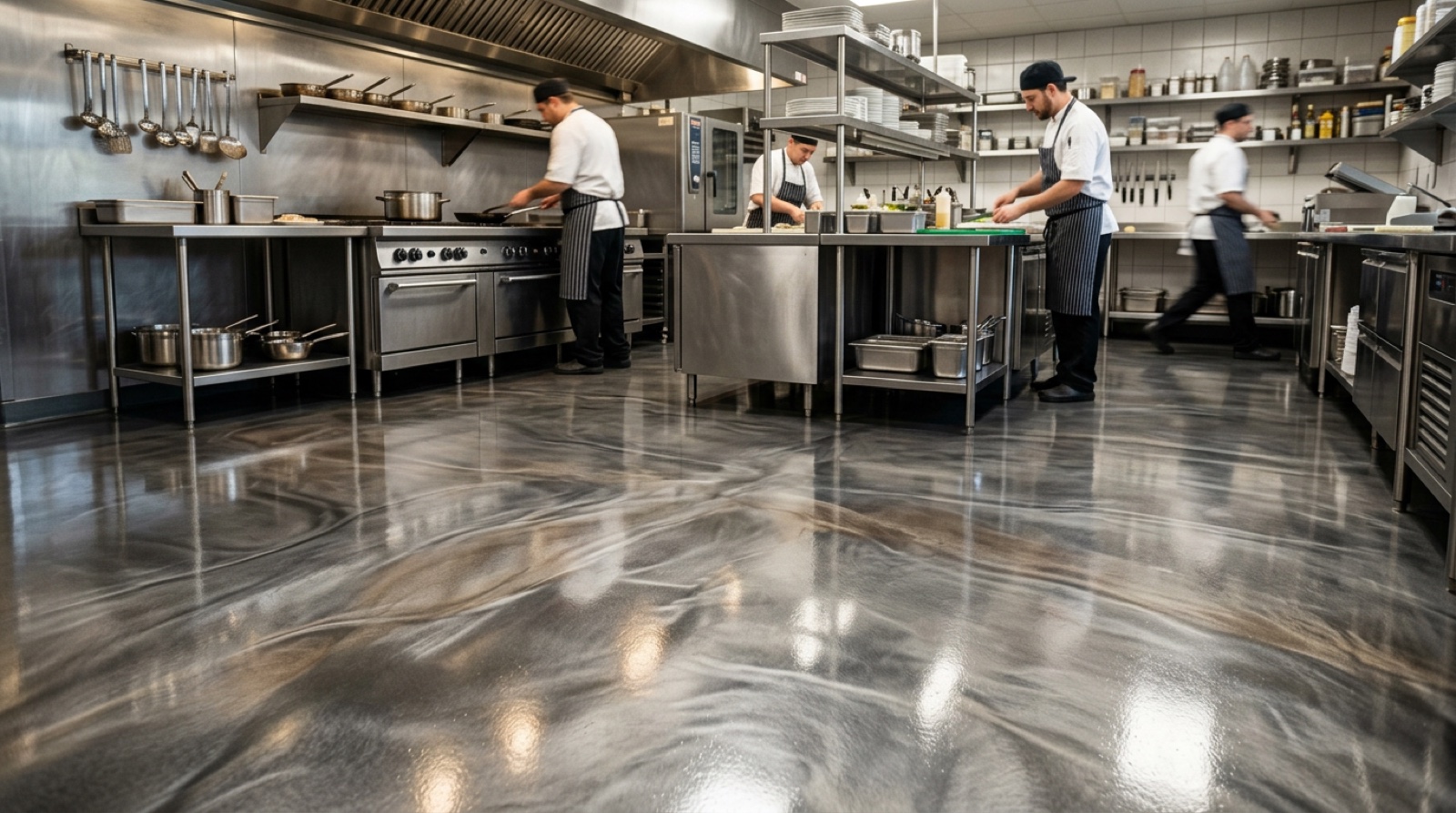
A seamless resinous floor removes the grout line entirely. There is no joint for grease and water to sit in, and coving the coating up the wall base eliminates the dirt trap where the floor meets the wall.
That is the core case for resinous flooring built for foodservice over tile in a new buildout.
Match the system to the zone
A restaurant is not one floor. Treating it as one is the most common way a coating fails early.
| Area | What it faces | System that holds up |
|---|---|---|
| Cook line and dish pit | Boiling water, grease, thermal shock | Heavy duty resinous system with aggregate for grip |
| Prep and walk in access | Standing moisture, cart wheels | Flake broadcast build with a textured topcoat |
| Dining room | Foot traffic, spills, appearance | Decorative flake or a polished finish |
| Bar and service corridor | Spot spills, constant turnover | Polyaspartic topcoat for fast return to service |
| Dry storage and back of house | Pallets, dollies, scuffing | Standard epoxy build with a chemical resistant coat |
Slip resistance matters most where water lands. A cook line needs aggressive texture, while a dining room needs enough grip to be safe without becoming impossible to mop.
That balance is a specification decision, not a product decision. Anyone quoting you the same texture for the whole footprint has not walked the space.
Downtime is the real cost
Material is rarely the expensive part of a restaurant floor. Closed days are.
Standard epoxy needs a cure window that usually runs several days before heavy equipment and traffic return. That is workable during a ground up buildout and painful during a remodel.
This is where polyaspartic topcoats change the math. They cure fast enough that a bar or dining room can often be coated after close and back in service the next day.
Polyaspartic also cures in a wider temperature range, which matters in a Rochester basement kitchen or an unheated storage area in February.
A note on existing spaces
Plenty of Rochester restaurants are moving into second generation spaces rather than new construction. Those slabs often carry old tile mortar, patched trenches and years of grease saturation.
None of that is a dealbreaker, but it does mean slab repair and profiling comes before anything else. A coating is only as sound as what it bonds to.
What to settle before the coating goes down
- Moisture test the slab. Vapor drive from below will lift a coating regardless of how well it was installed.
- Confirm drain locations and slope. Reworking pitch after the floor is coated means starting over.
- Decide on integral cove base early, because it changes prep at every wall.
- Degrease thoroughly. Old grease penetrates concrete deeper than most people expect.
- Sequence the floor against equipment delivery so nothing heavy rolls in during cure.
This applies well beyond restaurants
The same logic covers most of the commercial work happening around Greece, Henrietta, Brighton and Webster. Breweries, commissary kitchens, medical suites and retail backrooms all live or die on the same slab prep and topcoat decisions.
If your space is more warehouse than kitchen, the specification shifts toward abrasion and forklift traffic, which is the territory of heavy duty industrial systems. For customer facing floors where appearance carries weight, commercial coatings get specified for looks and cleanability together.
Whether the national chains land here in 2027 or later, Monroe County operators are already renovating. If you have a buildout or a floor that is failing, tell us about the space and we will walk it before quoting.